Wednesday, July 12, 2017

Back to Where It All Began.


In Misadventures in Catfishing Part One, I wrote at length about my experiences fishing with my cousins on the Kaskaskia River in Central Illinois. I was lucky enough to visit them just about every summer from my eleventh until my eighteenth year. Looking back on those times, if there was anything I regret it’s that I didn’t have a camera except for one of my last camping trips down there around 1990. 

The recent passing of my cousin brought me back to the area this past weekend. After the ceremony, I took  some time out to go walking along the river where we used to fish. As one might expect, a lot has changed in the past 30 years or so. Yet, in some other ways a lot has remained the same. Bank poles still line the river in places, but now they’re made of PVC pipe. I heard a small boat going up the river and around the bend...the song (of the outboard) remains the same!

Initially, I thought about how you “can’t go home again”. And in some ways, that’s always true with the passage of time. However, perpetual change is a constant with any river system. As I've said before every trip to the river is time well spent. 

Since I took a bunch of new pictures, I thought it would be fun to compare them to my old pictures. One huge difference is the water level. In my old pictures (taken with a 110 camera and eventually scanned), the water was very low due to it being a dry summer. In the recent pictures, the water level is up pretty good. Not bank full by any means, but a nice water level to run the river by boat and fish for some cats. 


View looking downstream from in front of the trailer...  


Here’s the beach directly in front of the trailer. The cut bank seems to have eroded. The river used to be shallow most of the way across until you got right to the cut bank section where it was several feet deep.  
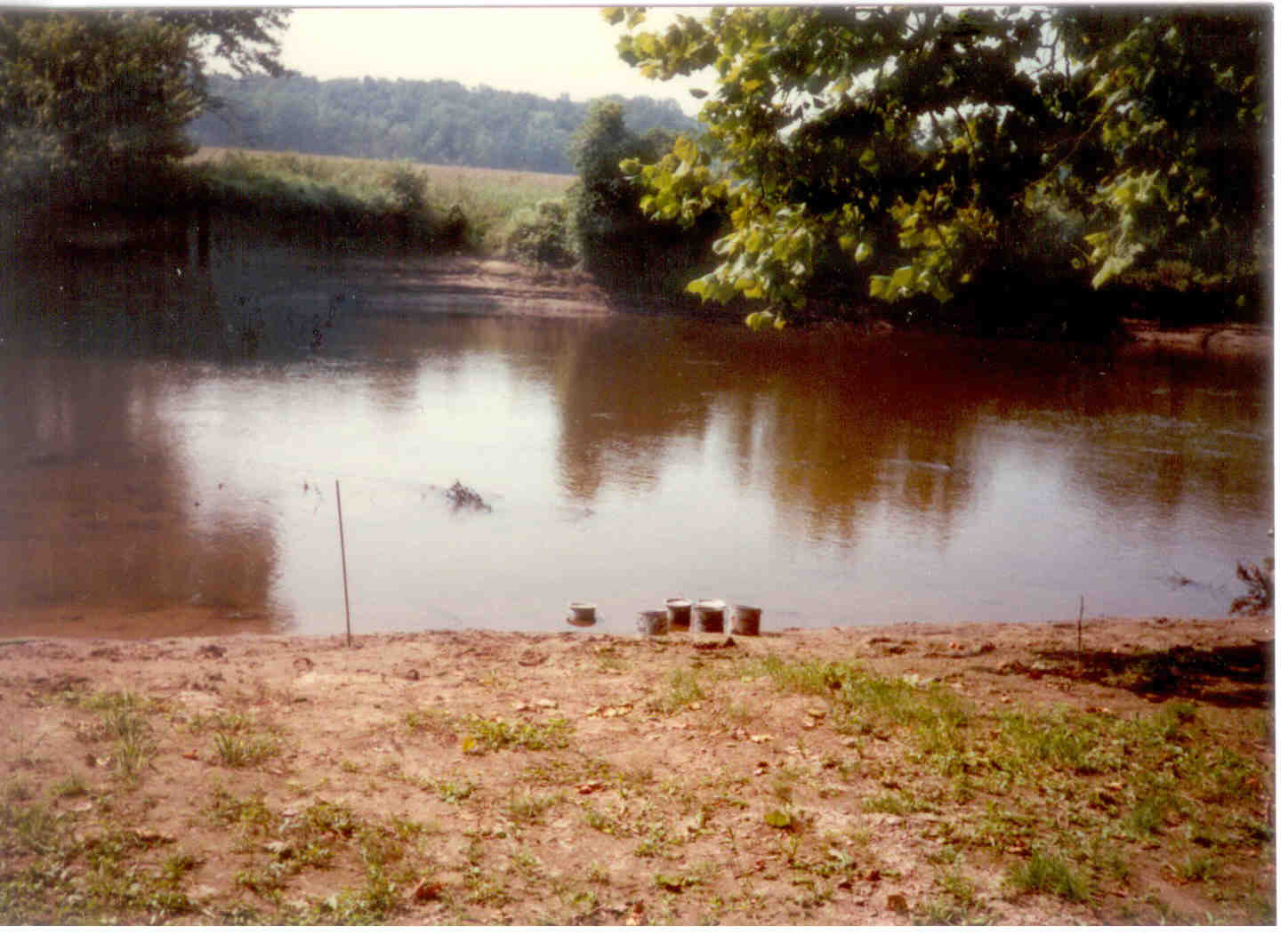

2017.
Looking up river towards the trailer. The trailer was just across from the point that sticks out on the left bank. The beach in front of the trailer would be on the right just past the old tree sticking out over the water.


View of the trailer from the beach area.  

Here’s a picture from the opposite bank looking towards where the trailer was. Most of the old beach would be under water, so it’s a little hard to tell how much has actually changed. They used to keep it mowed, it's all overgrown these days... 


Here a picture looking across the river from a spot near where the trailer used to be. As you can see it’s so overgrown now, you can hardly tell there was ever a fishing trailer there. And a lot of the old cut bank is gone...


View upstream towards Pee Wee’s Hole. Notice the big cutbank by the snag. That water along the cut bank opposite of the big sandbar was several feet deep, even in times of low water. 


In this panorama from the opposite bank, you can see the trees by the point by the snag. The cut bank has been eroded away due to the river cutting across the narrow strip of land there during periods of high water. While there’s still a good snag to fish, it’s changed quite a bit in the past 25 years since I’ve fished there. Just left of center there was a giant submerged log where the hoggers used to noodle for catfish and giant carp. Wonder if that’s washed away, silted in, or still there. Maybe someday I’ll get back there in a boat to find out!
  
Here’s an aerial view where you can see where the river was cutting across during high water. My guess is the waterline is in low water here is about the same place as where the old cut bank used to be. They’ve added a lot of rip rap here to counteract the erosion that’s been occurring. If the river keeps working on it, the big bend area that’s just upstream will become an oxbow. 


As a reference, here’s a larger shot of the area near where the trailer was. The trailer was situated in the lower right hand corner of the picture. The first big sandbar is the area we call Pee Wee’s Hole. There was a huge cut bank at the beginning section of the big bend in the river, opposite of the big sandbar area. I used to bank fish all along this area, we also ran a lot of bank poles back then too.


Here’s what the big bend looks like now. It used to be a steep cut bank, all dirt. They’ve added a lot of rip rap to counteract the erosion that’s been happening.

One last wide shot from a little further up the bend…the big sandbar is underwater, but the aerial photos show it’s still there. Except for all the rip rap that’s been added, this section doesn’t look at lot different. We used to get a few bank poles in along the old dirt banks.

No more willow or cane poles! 


As much as the river as changed, it still seems the same. Grateful for all of the fond memories!


Saturday, June 24, 2017

What's Luck Got to Do With It???


Do you believe in lucky poles, magic baits, or lucky hats? If so, this one might hit a little close to home!  Ask a good fisherman and they will often tell you that you make your own luck. In other words, luck is the result of preparation, planning, location, and timing. 

First let's deal with a few common superstitions:

Magic baits
 

Read about catfishing and you'll frequently see people that favor one bait over others. If there was ONE magic bait, would there be a thousand different prepared baits on the market for channel catfisherman? I don't think so! Not to mention how everyone has their own favored natural baits. Cats are attracted to specific baits based on scent/taste, vibration, etc; and cats can become conditioned to accept baits often fished in an area. However, most of the best catfishermen I know believe bait placement is a more important factor than bait selection.    


 Lucky pole


Okay, there might be a bit truth to this one; if you're more comfortable and have a better feel with a certain rod, it might work better for you. On a regular basis, I do see certain rods being hit a lot. Maybe it's because I like the rod so they're the first baits out. Whatever the reason, I can't totally rule this one out. 


The big ones come when there's no camera in the boat!


With the advent of cell phone cameras, there's really no excuse any more on this one. However, for years I've been a believer in always having a camera in the boat and still live by that rule. So this one has been a non-issue for me for years. Sometimes the camera strap accidentally gets in the picture or the flash goes off at the wrong time.


Lucky hats

Come on, let's get serious now. How does the fish know what hat you've got on? I have a confession to make on this one...I have two catfishing hats and I ALWAYS have one of them one. When I recently misplaced my favorite fishing hat, my old Procats hat, you would think I lost my wallet with all my credits cards. Actually, wallets and credit cards can be replaced. Fortunately, the missing hat turned up and all is right with my world again!


Hit came when I wasn't watching!


This one perplexes me. It does seem to happen a lot where a rod goes down and I'm tying a knot, checking my phone, snapping a few pictures, taking a whizz, whatever. But how do the fish know?!? Maybe I'm just tinkering around with stuff a lot some nights. Again, I can't rule this one out because sometimes I've joked around saying I'll start rigging another pole to get some action going and it's happened. Crazy.

Okay, enough about superstitions.

I do feel that as fishermen become more experienced, they naturally become less superstitious (hopefully). I do think it's somehow an integral part catfishing lore to talk about superstitions and good luck/bad luck. I also think the best catfisherman don't spend a lot of time worrying about luck and superstition. Other factors are much more relevant.  

Confidence 

Confidence is highly underrated. He who hesitates may miss the hook-up... a habit of successful fishermen is to remain focused when things get exciting. Become overexcited when the big fish finally hits your less likely to land the big fish. Human error inevitably raises its ugly head! When you keep your cool, stay focused, and confidently wait for the right time and set that hook assuredly and confidently - without hesitation - you increase your chances of landing that fish.   


Discipline 

Most of the best fishermen I've talked to about fishing for catfish, especially big catfish, reiterate the same message - you have to be prepared to NOT catch fish, in order to catch fish. This means knowing you will go out and spend some time when the fish either aren't home, or aren't cooperative. You may need to wait very patiently several minutes or more for the right time to set that hook, after the initial signal you received. Most importantly, discipline is sticking with your plan and not switching to worms or cheese bait because the flathead bite is slow fishing with bluegills. Or breaking out the oars to get to the next spot when you had engine trouble but still want to fish. You have to stick with the plan, because you don't know when that big cat is going for a take-down. If you switch to cheese bait because the flathead bite was slow, you'll never find out.

Discipline is having your gear organized and knowing where all the important stuff is in the boat at night. And having the right gear and tools in your catfish bag every time out. For those of us with a short attention span, waiting for that next hit definitely requires concentration and focus. Staying focused when the bite is slow can be a real challenge some nights and the ability to maintain concentration is often the difference between getting that next catfish in the boat and getting skunked. 


Experience
Experience really is the best teacher. The best way to learn it to be out on the water. Successful fisherman may talk about luck, but it's more likely they are successful because they've taken the time to search out prime fishing spots and learned how to present their offerings in the right place at the right time to catch fish. Most importantly, time on the water leads to success. Night after night every summer the better catfishermen are out there searching for the next big cat. One thing that's guaranteed - you won't catch fish sitting at home.


    Blazing a new trail

Another habit of successful fisherman is exploring new spots each time out, instead of only visiting their favorite "honey holes" over and over. The fishermen who aren't out there exploring new territory won't learning nearly as much about the body of water they're fishing as the guys who consistently search out and fish new spots (another confession, I don't do nearly enough of this myself). We've all been told over and over not to just keep going to the same spot you've caught fish before. As Denny Halgren says, "A spot has to prove itself to you over time." So while it is good to have a catalogue of "top shelf" spots in your mind, don't be afraid to explore and learn about new places. Even if you've found the best catfish habitat ever, just remember there was that first time you anchored there not knowing what would happen...   

So the next time you're feeling superstitious because you can't find your lucky hat, just forget about it. Luck is being in the right place, at the right time, with the right bait. That's all it is. 

Thursday, May 11, 2017

A fond farewell to all the cats in the pond

This week marked the end of my fishing privileges at the pond where my mom lived for over 20 years. In that time, we had a LOT of fun rowing the boat around, watching turtles, catching bass, catching sunfish, and catching channel cats. 

I don't really have a lot of deep thoughts to share about all this, but it did seem appropriate to do a blog post this week and share some pictures and a little video. While I'll miss fishing at the pond, more than anything I'm just grateful for all the time spent during family trips down there. Nothing beats a nice home in a quiet setting away from all the noises of the city with a pond full of catfish.

I hear the new property owner has already been scoping things out in his kayak, which I think is pretty awesome. Sounds like the right people moved in!


a little video featuring one of the sloppiest hooksets you will ever see...


Sunday, April 2, 2017

Spring Training

I was out collecting some worms the other morning...that got me to thinking about the annual ritual of getting ready for that first time out. It's not terribly involved, but there's a handful of basic things that comprise my process of getting ready for the upcoming season.


Inventory
Simply put, this is making sure there's enough hooks, sinkers, line, etc. This spring I'm re-spooling a few reels with 80 pound Power Pro and some more heavy mono, which I already have on hand. I haven't gone through my terminal tackle yet, but I'll be doing that very soon. I should be in pretty good shape, maybe some more 2-3 oz sinkers for this season.Maybe a little oil or grease for some reels and I usually get the tackle boxes and bags organized along the way too.


Maintenance
I tend to do the minimum in this area. With a small boat and trailer and mostly local trips, I haven't had to repack bearings in a while. I'll put some more varnish on the wood decking in the boat this spring, might try to clean up the wiring a bit more. And I'm always looking to maximize space a little better. Other than that, I'll check my trailer lights and tire pressure, squirt a little grease in the hubs, and I'm about ready to go with the boat and trailer. I store my outboard in the garage during the winter, so it doesn't take too much to have it ready to go. I'll drop the motor in the water for a tank test before heading out the first time, just to make sure it's running good.   


Worms
When the nightcrawlers come out the first few times, I'll try to collect a couple dozen to keep in the refrigerator. It takes bait to catch live baits, plus you can also use nightcrawlers for channel cats or just fishing with the kids. I try to keep them on hand throughout the season so I don't have to run out to the bait store at the last minute when I'm about to head for the river.


Warming up
As the days start getting longer in the springtime, the temperatures are also (hopefully) climbing. Once you get into mid-May, the water temps are generally pretty steady above the 60 degree mark. Typically, they say flathead can be caught when the water is above 50 degrees. That may be true, but one thing I've noticed is when the water reaches 60 degrees a more reliable active bait occurs. I like a more active bite, so I start to get really enthusiastic when the water temps get into the 60s and above.


The wind-up
Basically, all these activities lead up to getting out on the water for that first trip. Once everything is checked out, it doesn't take much to get out on the water. Batteries and lights need to get charged and tested, gear needs to get packed and loaded, and you're off to the launch.  Or the bank.
(I did a previous blog post about catching baits, but I'll I try to have at least a dozen baits for a few hours of fishing. If I'm fishing 5-6 hours, I probably take along 16-18. When I'm going out with another angler, around two dozen). 


The pitch
Everything finally culminates in that most optimistic moment of the season - anchoring on the first spot and tossing out the first bait!
(the waiting begins...)